GUIDE / PLATFORM EVALUATION
Evaluate the system behind the screen
School platform evaluation should compare verified workflows, role permissions, implementation effort, support, privacy, data ownership, exports and exit conditions against the school’s actual needs. A concept screen can explain an idea, but only current product evidence can support a capability claim. Easy Edu’s present timetable interface is illustrative, so its modules must be confirmed before procurement decisions.
Reviewed draft · 14 September 2026
KEY TAKEAWAYS
What should the reader carry into the decision?
- Confirm the product name, release status and current module list before treating a screen as a capability.
- Test ordinary workflows and exceptions across the roles that create, approve, correct and view each record.
- Count configuration, migration, identity setup, training, support and school staff time as implementation work.
- Request written privacy, data-flow, retention, export, deletion and incident evidence for the exact service.
“Retain full control over your data with tools that help you manage how, when, and where data can be accessed.”
Google for Education
Method and scope. This vendor-neutral matrix was reviewed against official Google privacy material, Malaysia's PDP guidance and the DELIMa platform context. Those sources do not validate Easy Edu or establish a partnership.
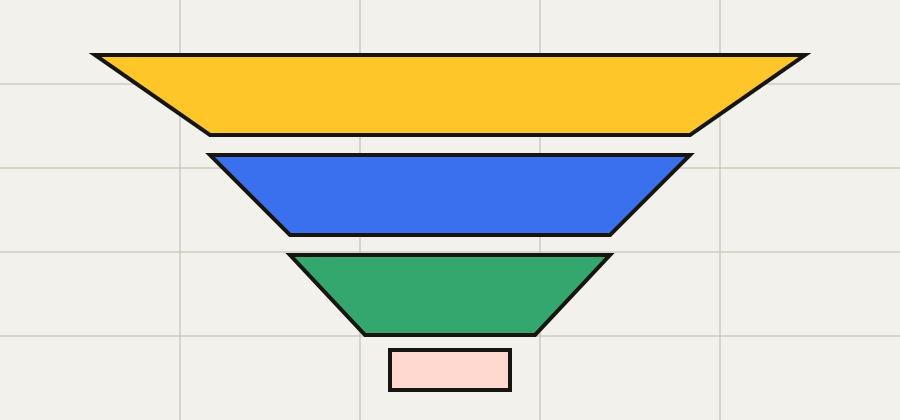
Which school problem should the platform solve?
Name the work that currently causes delay, duplication, missed communication or uncertainty. Identify who performs it and who experiences the result. Set a measurable decision criterion such as fewer duplicate entries or clearer responsibility, without assuming the platform will achieve it. The criterion is a way to evaluate evidence during a pilot, not a promised outcome from a vendor.
Turn the opening problem into an acceptance statement. For example: authorised staff can correct a timetable change once, affected users see the approved value, and the earlier value remains auditable. This gives the evaluation a testable result instead of a broad wish for better communication.
UNESCO reports global internet connection rates of 40% for primary, 50% for lower-secondary and 65% for upper-secondary schools. Source: UNESCO 2023 GEM Report →
- 01Current process
- 02People affected
- 03Decision criterion
- 04Evidence window
How can a school separate product status from product vision?
Ask for the product name, release status, supported environments and current module list. Mark every demonstrated element as released, planned or illustrative. Request real screenshots and permission to retain them with the evaluation record. A coherent visual concept can be valuable, but it should never be mistaken for proof of operational software or current customer use.
Use four status labels: released, planned, illustrative and out of scope. A released item needs a current demonstration and document; a planned item needs a commitment before it can enter procurement scope. The Easy Edu timetable screens remain illustrative until the company provides a product record.
UNESCO reports that 85% of countries have policies intended to improve school or learner connectivity. Source: UNESCO 2023 GEM Report →
Which complete workflows should a school test?
Select several ordinary scenarios and follow each across roles. A feature should be understood through inputs, permissions, decisions, outputs, exceptions and correction paths. Ask what happens when a teacher changes class, a guardian has several children, a student transfers or an administrator corrects a record. Exceptions often reveal more about implementation quality than a happy-path demonstration.
Test the normal path and one exception from start to finish. Record origin, approval, correction, notification, audit history and support handoff. A menu or isolated screenshot cannot establish that chain, and success for one role does not prove the experience for another.
UNESCO reports that about two-thirds of education-software licences in one United States analysis were unused. Source: UNESCO 2023 GEM Report →
- Input
- Record the result
- Permission
- Record the result
- Exception
- Record the result
- Correction
- Record the result
How should implementation effort be evaluated?
Request a written implementation plan covering configuration, data preparation, migration, identity setup, training, pilot, launch and ongoing support. Identify which tasks belong to the school and which belong to the vendor. Ask what must be ready before each milestone and what happens if the academic calendar changes. Total effort includes staff time and process change, not only a software fee.
Price the work around the platform as a responsibility table: configuration, migration, identity setup, training, testing, launch support and ongoing support. Name school and vendor owners for each row. Easy Edu's delivery model is unverified, so the table is a request, not a service promise.
Malaysia's Personal Data Protection Department sets out 7 personal-data-protection principles under section 5(1) of Act 709. Source: Malaysia Personal Data Protection Department →
Which privacy and security evidence should be requested?
Ask for the privacy notice, data-flow diagram, roles of controller and processor, hosting locations, access controls, audit history, retention, deletion, incident process and subcontractors. Google for Education’s official privacy material illustrates the kind of topics buyers may examine, but it is not evidence about Easy Edu. Each vendor must supply its own current documentation.
The evidence set should include the current privacy notice, data-flow diagram, roles, hosting and subcontractors, access controls, retention, export, deletion and incident response. Malaysia's Personal Data Protection Department provides general legal context; the actual arrangement still needs professional and contractual review.
UNESCO reports that only 16% of countries explicitly guarantee data privacy in education by law. Source: UNESCO 2023 GEM Report →
- Data flow
- Access control
- Retention
- Incident process
How should a school test export and exit before adoption?
Confirm how the school can export records, the available formats, time required, costs, deletion process and evidence of deletion. Identify integrations that would stop working and the responsibility for reconciliation. Exit terms reveal whether the school can retain control of its information and avoid a hurried decision when a contract, vendor or school requirement changes.
Define the exit acceptance test before entry. Request a sample export with usable identifiers, fields, attachments and timestamps, then ask how active data, backups and logs are deleted. Record timing, cost and responsible contacts so exit is an operational plan rather than a clause read at the end.
UNESCO reports that 39 of 42 governments in one pandemic-era analysis promoted online-education uses that risked or infringed children's rights. Source: UNESCO 2023 GEM Report →
| Check | Status | Evidence |
|---|---|---|
| Export format | Open | Attach current record |
| Timing | Open | Attach current record |
| Deletion | Open | Attach current record |
| Transition responsibility | Open | Attach current record |
Continue with the role-flow guide when permissions and exceptions need a full matrix. →
QUICK ANSWERS
Frequently asked questions
Does a concept screen prove that a school-platform feature is live?
No. Label every item released, planned, illustrative or out of scope, then request a current demonstration and dated documentation for released functionality. The Easy Edu timetable screens are illustrative and do not establish live modules, integrations, users, controls or outcomes.
Which workflows should a school test?
Choose ordinary scenarios such as a timetable change, attendance correction, result publication or guardian query. Trace each input, permission, decision, output, exception and correction path across roles. Record the product version and retain the evidence that supports each observed result.
What exit evidence should be requested before adoption?
Request a sample export, formats, included fields and attachments, timing, cost, deletion process, deletion evidence and transition responsibilities. Test non-sensitive sample data before relying on the contractual right, and ask what happens to active data, backups and logs after the service ends.
See every guide in the insights index →
EXTERNAL CONTEXT
- Google for Education: Privacy and security
- DELIMa: Official Malaysian digital education platform
- Malaysia Personal Data Protection Department: principles
- UNESCO: 2023 Global Education Monitoring Report
External sources explain category or evaluation context. They do not endorse Easy Edu or prove its product capabilities.
NEXT MOVE
Run the evidence check as a session
Use the workshop structure to assign roles, test scenarios and record every evidence gap.
Plan the evaluation session